The End of Dodd-Frank Part 2: But Who Will Save OLA?

This post is part of my ongoing series on provisions of the Dodd-Frank Act which have been under attack by conservative, and some liberal, forces. For Part 1 on the Volcker Rule, click here.

2007-08-18-DeutscheBankfire

Fox News, depicting another kind of orderly liquidation of a bank.

Who Should Break Up The Banks?

As I mentioned in a blog post outside of this series, the presidential campaign of Bernie Sanders has given this topic a lot of media coverage. Some of that has been good: it has reignited public interest in bringing back the Glass-Steagall Act, and despite what opponent Hillary Clinton says, the Dodd-Frank Act’s Volcker Rule is no replacement for that act. But other parts have not been so great: after all, the Dodd-Frank Act is a complicated piece of legislation that became an even more complicated mess of regulatory rules from multiple government agencies and conflicting case law by various different district courts.  The one major success the finance industry had with it was to force compromises that had even more strength in the confusion they add than the actual loopholes they create. And as I talked about in that blog post, Bernie Sanders’s campaign has stated that it wants to use the Mitigation of risks to financial stability provision, 12 U.S.C. § 5331, to break up the “too big to fail” banks in his first year. As I mentioned, that is pretty much politically impossible given the legislative requirements and just how many banks qualify as “too big to fail.”

This post is going to look at another provision: Orderly Liquidation Authority (OLA) as laid out in Subchapter II, Chapter 53 of Title 12 of the U.S.C. Interestingly, Hillary Clinton in the debates has hinted that she would use this authority, specifically to go after disreputable or insolvent financial institutions. While I certainly am aware of how friendly Clinton is with the captains of finance, it is a fairly risky move on her part: OLA is largely despised by even the more liberal economists. The usual “doom and gloom” narratives (funny how they’re never about the things that actually cause recessions) have been put forth by orthodox economists of all stripes. Stephen J. Lubben, Seton Hall University School of Law corporate apologist and neo-colonialist, wrote in his piece for the New York Times “The Flaws in the New Liquidation Authority” that OLA “…is apt to destroy going concern value and result in greater market disruption…There are no easy solutions, and probably failure avoidance is a better aim than any of the proposed resolution mechanisms.” In other words, Lubben wants the market to be allowed to “self-regulate” (shocking I know). As Lubben mentions, others like the Hoover Institute want to utilize some form of bankruptcy proceeding instead of OLA. But before we delve into the alternatives, let’s look at a basic outline of what OLA is.

Previously, when a financial institution was on its way to failing, it would be handled in a fairly similar way to any company failing: through a bankruptcy proceeding. But the government, in a rare moment of clarity that only a major economic downturn can bring, realized that institutions like Lehman Brothers would not conduct themselves properly and that, rather than file for bankruptcy in a timely manner, would postpone it through accounting fraud, misinformation, and perjury. So, Congress decided to create the OLA provision of Dodd-Frank to ensure that major financial institutions would not be allowed to put themselves in the same kind of situation that Lehman Brothers was in. The process was taken out of the Bankruptcy Courts, modified to take away power from financial institutions, and handed over to the Federal Deposit Insurance Corporation (FDIC), an independent agency of the government whose whole purpose is to insure the deposits that people make at the banks they govern (I am going to stay out of the broker-dealer provisions, which are governed by the Securities Investor Protection Corporation). This change of venue is already upsetting to the finance industry: the priorities of a Bankruptcy Court have increasingly been to garner whatever capital possible for financial institutions, whereas the FDIC is looking out for the consumers (note: for many reasons, this is not the same as looking out for communities or the public, but it is an interest often in opposition with that of the major finance companies).

The FDIC’s Ten Step Programme

An orderly liquidation is a 10-step process:

  1. The Secretary of the Treasury, after an investigation, finds that a financial institution is at risk and contacts the FDIC and the financial institution to request that the FDIC be appointed the receiver of the institution. The institution has two options: accept, which takes it to step 4, or oppose.
  2. If the financial institution opposes the request, the Secretary petitions a federal district court to force the financial institution to accept the receivership of the FDIC. There is a closed, confidential hearing where the court evaluates whether or not the Secretary’s determination of the institution as at or dangerously close to default is “arbitrary or capricious.” Capricious means prone to sudden changes in mood or behavior.
  3. The court has 24 hours to deliberate. If it fails to make a determination, the FDIC will automatically be granted receivership. Otherwise, however the court rules, it can be appealed by either the Secretary or the financial institution to first the Court of Appeals for the DC Circuit and after the Supreme Court.
  4. If the financial institution accepts the initial request for receivership, the court fails to make a decision within 24 hours, or the court and any further appeals rule in favor of the Secretary , then the FDIC is granted receivership of the financial institution for three years, with two possible extensions of an additional year each.
  5. The FDIC as receiver now has six major responsibilities: (1) to prioritize the stability of US financial markets over the continuance of the financial institution (2) ensure that shareholders of the institution are the very last to get paid (3) ensure that unsecured creditors bear some of the losses (4) ensure that the management responsible for the condition of the institution are removed (5) ensure that members of the board of directors who contributed to the condition of the institution are removed (6) not take any equity interest in the institution.
  6. If you could not guess from that list, the FDIC now has near-complete control of the financial institution, and may conduct it in anyway that the normal management lawfully would.
  7. But unlike the normal management, the FDIC will be focused mostly on the complete liquidation of the financial institution by selling off some of its assets and transferring others to a “bridge company.”
  8. A “bridge company” would be an entity created by the FDIC through their receivership. It would be created in a similar manner and operate in a similar way as any corporation, with the Board of Directors being appointed by the FDIC.
  9. Once enough of the assets have been sold or transferred to bridge companies to avoid applicable antitrust law, the FDIC may choose to merge the rest of the institution with another financial institution upon that institution’s consent.
  10. However it may be partitioned out, the assets will be completely liquidated within 3 – 5 years without any costs being borne by the taxpayer. Think of it like leftovers that are about to spoil in a house of four people: you might eat some, give some to your roommates, reincorporate it into a new dish (leftover rice and beans always winds up becoming a burrito for me), and probably throw some of it away.

So What Does It All Mean?

If you think this is complicated, this is actually a major simplification of the enormity of particular limitations and additional regulations, judicial and other agency oversight of the process from beginning to end, and rules for handling outstanding lawsuits and other obligations against the financial institution.

But it does not require that comprehensive of an understanding to see that OLA actually has a fair amount of power within it. So does this makes Hillary Clinton’s preference for it more radical, or at least realistic, than Bernie Sanders’s congressional-led bank dissolution? Not necessarily. While the 24 hour default on judicial judgment is one of the strongest regulations in the sector, there are two major stumbling blocks to the process: prior to receivership, the evaluation of risk, and during receivership, the creation of bridge companies.

Risk Is The Game

As I have stated before, risk is the foundation of the finance industry. Capitalism is full of contradictions, or perhaps seventeen major ones as David Harvey divides it, and as Harvey writes one of the clever schemes of capitalism is the ability to utilize these very contradictions for the purpose of capital accumulation. A government beholden to capitalism, as ours is, will always have two interests: to mitigate risk to forestall or manipulate recession and to allow and facilitate a certain amount of risk in the markets. One of the beauties of OLA is that it provides a window for how the government views the relation between the risks of individual corporations and the systemic risk of the finance market.

This is reflected in 12 U.S.C. § 5383, which stipulates the following factors for systemic risk evaluation:

(1) an evaluation of whether the financial company is in default or in danger of default;
(2) a description of the effect that the default of the financial company would have on financial stability in the United States;
(3) a description of the effect that the default of the financial company would have on economic conditions or financial stability for low income, minority, or underserved communities;
(4) a recommendation regarding the nature and the extent of actions to be taken under this subchapter regarding the financial company;
(5) an evaluation of the likelihood of a private sector alternative to prevent the default of the financial company;
(6) an evaluation of why a case under the Bankruptcy Code is not appropriate for the financial company;
(7) an evaluation of the effects on creditors, counterparties, and shareholders of the financial company and other market participants; and
(8) an evaluation of whether the company satisfies the definition of a financial company
Currently, we can to a certain extent  expect Secretary of the Treasury Jacob Lew, as unsavory as he is, to be a good Neo-Keynsian and enforce these provisions with good faith. However, some of them will vary in their enforcement: for example, a Republican Secretary may assert that things like payday loans are beneficial to the economic conditions or financial stability for low income, minority, or underserved communities.
But one provision that is trouble regardless of who is Secretary is (6). This provision, contrary to what the laissez-faire proponents will tell you, is actually meant to give the Secretary leeway to not use OLA and to employ Lubben’s “let the market decide” principle. But the very conditions that gave birth to Dodd-Frank show the danger in trusting that private solutions should be looked at first: whether rumor or based on actual statements, several banks were thought to be the ones to buyout Lehman Brothers to prevent its bankruptcy. When you allow the Secretary to make evaluations based on private solutions, there is a high risk of this happening again, since the management of banks is by its nature “capricious.” It is not that private institutions may not be able to solve every systemic risk, it is that private institutions will never be able to solve many systemic risks. They are beholden to their corporation alone, and while some smarter players in the sector fight to prevent systemic risks, these exceptions can hardly outbalance those who will watch the fire burn it down as long as they can collect on the insurance. This provision needs to be amended out: the finance industry has plenty of cheerleaders, and the Secretary of Treasury being one in any instance is a major conflict of interest. Unfortunately that may be inevitable given, as I have previously state, that the Secretary has for the past few decades always been a finance insider.
Bridge Burner
I actually agree, at least as a short-term intermediary matter, that the creation of bridge companies is a good means to avoid the liquidation triggering antitrust violations. However, I disagree strongly that they should be regular private corporations. Rather, I think it is best for them to be independent agencies modeled on the FDIC. Transferring, or even selling, the assets will not necessarily decrease systemic risk in and of itself (sorry Bernie and Hillary, breaking up the “too big to fail” banks is not good enough). Many of these assets, as most clearly seen in the mortgage foreclosure crisis which was a whole mess of bad faith tainted assets, are toxic. A private corporation could likely continue or even exacerbate the damage of these assets: after all, their goal is to make money, not to prevent systemic risk, even though that is the very motive that gave birth to them. Instead, independent agencies could take the time necessary (and unavailable to the FDIC under receivership) to gradually detox assets with a priority given to prevent both systemic risk and harm to the individuals caught up in the assets. These priorities may be difficult to balance: preventing systemic risk would usually be aided by action as quickly and comprehensively as possible, but such action could intentionally, recklessly, or negligently harm people, especially the low income communities that are so often exploited by such assets.
The End Of Orderly Liquidation Authority
So those are the short term problems and remedies, what is the future of Orderly Liquidation Authority? OLA is a prime example in public policy where a good offense will be far better than a defense at protecting it. People remember what went wrong far more than what went right, so the OLA is already at a disadvantage. However, the banks are the bane, if not outright enemy, of most people and they would love to see a very public execution. The Treasury Department talks big about how important OLA is, but so far this in theory far more than in practice.
There are plenty of targets. The Treasury Department needs to show, publicly and vigorously, that OLA can work, and they need to do it soon or there could be devastating consequences.

The A, B, C’s of Monopoly

alphabetWhile all eyes were on the travesty that poses for democracy in Iowa, Alphabet (formerly Google) quietly posted its fourth (and first as Alphabet) quarter earnings February 1st. I say quietly because it was not put out in the media in a way that Alphabet is easily capable of, but it certainly generated buzz in the business world. Alphabet, as you may have missed since the media is dedicated to keeping you ignorant about such things, was Google’s reorganizing into a holding company. Announced as a move to save the world with risky (at least from an investment perspective, and not the good kind of risk) technological innovation, it was in actuality as profit-driven as any other company restructuring. Google has been around for over a decade as a publicly-owned corporation and has reached a maturation point that is just as much about long term debts accrued as it is about growth and profitability. It was, in a sense, inevitable, and Google was smart enough to seize the opportunity to diversify their investments formally.

Here is a question without an easy answer: is Alphabet creating or going to create monopolies?

Search engine analysts comScore puts Google’s market share at 63.9%, with their “rival” Yahoo at 12.6%. Market share is calculated by the sales of the company in a particular period over the total market sales. Analysts really focus on it in two instances: when the quarterly earnings are posted and when a major change is being made, such as the introduction of a new product. Alphabet did both, and so many analysts like comScore are interested in where it is going, particularly in that Yahoo’s market share increased as well.

The increases of other companies are important based on the Herfindahl-Hirschman Index (HHI). HHI is calculated by a very simple formula: the sum of each corporation’s market share squared. The higher the score, the more likely that there is a monopoly (economically speaking, we’ll talk in a sec about why the law makes this even more complicated). For example, if one company owns the entire market, 100%, the HHI would be 10,000, but if 100 companies owned 1% each, it would be 100. The Department of Justice’s standard for a “highly concentrated” market is 1,800. The search engine market currently has a HHI of 4,674.79, or about 2.6 times the standard. To give a standard of comparison, the recently struck down merger between US Foods and Sysco was in the context of the possibility of the grocery market HHI increasing to 5,836. But the HHI at time of the attempted merger was 3,036 – why had the Federal Trade Commission not taken action sooner?

Because they intervene during mergers when the HHI is above 2,500 and the merger would result in an increase of more than 200. The attempted US Foods – Sysco merger would have been an increasing of about 2,800, 14 times that amount. This law, 15 U.S.C. § 18, is very good at stopping competition-killing mergers as egregious as that attempted by US Foods and Sysco: but what about “highly concentrated” markets that exist outside the context of mergers?

There are a few other ways for both the government and private parties to go after companies who are creating monopolies or abusing monopoly power, but for the purpose of length I will focus on the one that I think could potentially be used against Alphabet at some point: price discrimination. This antitrust doctrine was at the heart of the most famous antitrust case of our time, U.S. v. Microsoft, which is very instructive in understanding the doctrine. But before we delve into the case, let’s cover a few more basics.

In rational actor economic logic, a monopoly is dangerous because it restricts the ability of individual consumers to “choose” the most “fair” price. The law, which has followed this logic increasingly since the 1970’s, reflects this logic in its regulatory capacities, and also reflects the inherent contradictions. Most notably, the law is extremely hesitant to ever intervene in monopolies when said monopolies are a product of the “invisible hand” of the free market. It is perfectly legal for monopolies to exist, and they exist everywhere in the United States. But what is illegal is when a company “…acquires or maintains, or attempts to acquire or maintain, a monopoly by engaging in exclusionary conduct “as distinguished from growth or development as a consequence of a superior product, business acumen, or historic accident”.” U.S. v. Microsoft, 253 F.3d 34, 58 (2001) quoting U.S. v. Grinnell Corp., 384 U.S. 563, 571 (1968). Price discrimination, as an abuse of monopoly power, is not necessarily against the law: it must be price discrimination with the specific intent to monopolize.

But where do we find the price discrimination in a company that offers many of its key products for free? After all, while Microsoft was sued for their operating system, most of those operating systems were bought in the context of a whole computer, and the Court found that it could be parsed out from the associated “middleware.” So how do you nab Alphabet? As George Monbiot argues in his piece for the Guardian examining the European Union’s attempts to bring Alphabet (then Google) in line, regulators are stymied by a reliance on traditional concepts of property and consumption. And the allegations then by the EU that Google was attempting to use its search engine powers to exert control over markets seems to have been not only ineffective at stopping them, but a roadmap to the reorganization as Alphabet.

alphabet

Here is the new structure of Alphabet. While this structure is allegedly built on the premise of sustaining riskier investments with Google’s earnings, it also serves to protect Google’s current search engine monopoly and foster new potential monopolies. How Google will get around the monopolies that are far more traditional (a monopoly on driverless cars for example) remains to be seen, but in each aspect Google is attempting to plant flags on yet-to-be-conquered (or in some cases, invented) markets. It is preemptive competition edging, and it is as brilliant as it is incredibly worrisome. With the growth model inherent in all of capitalism (sorry greenwashing corporations), we may be looking at a future where Alphabet establishes cross-market domination not through traditional mergers and acquisitions, which would most easily trigger regulation, but purely through technological innovation investments rivaled only by the U.S. Government (and of course the relationship between the two has been steadily increasing).

There is not a lot of hope here. Normally corporate power is most easily undermined through organizing their workforce, but Google’s workforce is less proletariat and more the new bourgeoisie class. Changes to monopoly regulation could work, but with our current electoral system they may be impossible and would certainly be far too little too late. My only possible solutions are the following two, and they are admittedly longshots:

  1. Push hard to create worker ownership in markets essential to the current neoliberal capitalism, and especially those essential to Google.
  2. Push hard for the U.S. government to divest from military spending and reinvest that money into innovation, particularly in the realms of infrastructure, life sciences (which will be in direct competition with both Alphabet and the Gates Foundation), and organization through technology (the fact that Google created Docs before the Left created our own equivalent has been an enormous blow).
  3. Do not accept Googleocracy. My generation is so willing to be critical of banks, fast food, and other major corporations but we often have a soft spot for companies like Google: after all, if you’re transgender or care about the environment or any number of issues, it seems like Google is on your side. But absolute power corrupts absolutely – we must assert faith in democracy over “benevolent” capitalism, because in the end capitalism can only be so “benevolent” in order to sustain itself.

Support my work through a $1 or $5 donation!

Bernie Won’t Break The Banks

Bernie Sanders

Picture from washingtontimes.com

Bernie Sanders got 2016 started by a speech in NYC on one of his favorite issues: the regulation of the banking and finance industry. As one of the defenders of Glass-Steagall back when it was being chipped away at in 1999, Sanders is able to position himself as a “Cassandra of Troy” figure to liberals who might otherwise be reluctant about instituting serious financial regulations beyond the Dodd-Frank Act. Along with income inequality, it is an issue which he has a tactical advantage over any of the other presidential candidates as the only one to admit in anyway that the financial industry is what it is:

Greed, fraud, dishonesty and arrogance, these are the words that best describe the reality of Wall Street today.

While I might disagree on fraud, only because most things normal people consider fraud is perfectly legal in the context of mass financial capital accumulation, it is the most honest description of the captains of capitalism by a major presidential candidate since Eugene V. Debs. But the question is what policies will, and more importantly can, Bernie enact as president? Let’s break down the ones he talked about during his speech:

Breaking Up The Too Big To Fail Banks

First, we have his proposal that he will break up the “too big to fail” banks under Section 121 of the Dodd-Frank Act. Legislators tend to refer to laws based on how they were passed in Congress, but this can be somewhat misleading at times: what we really want to look at is the corresponding section of the United States Code, 12 U.S.C. sec. 5331. This provision does indeed set up a system to “break up” the banks, but it is sufficiently complicated as to put into doubt whether a President Sanders could break up even one, let alone all, of the “too big to fail” banks in his first year.

Banks that are governed by this section must hold $50 billion in assets. That sounds like a lot of money, but not in the banking world: the top 38 banks in this country all hold over $50 billion in assets, and to redistribute the assets of giants like the over $1 trillion top four banks would likely push a lot of the other banks into the over $50 billion range. Which isn’t to say that breaking up these banks is impossible: I just want to give a scope of what a large project it is. It is also worth noting that there is a major limit to what the U.S. government can do at all since, as Forbes reports in 2014, not a single U.S. bank is in the top five banks of the world for asset holdings.

Then there needs to be a 2/3 vote of Congress approving the Federal Reserve taking action. With every. Single. Bank. Let’s all keep in mind how much Congress has gotten accomplished in the past ten years. Even after that, the Board of Governors is required to run through alternative solutions before breaking up the bank, particularly:

(1) limit the ability of the company to merge with, acquire, consolidate with, or otherwise become affiliated with another company;
(2) restrict the ability of the company to offer a financial product or products;
(3) require the company to terminate one or more activities;
(4) impose conditions on the manner in which the company conducts 1 or more activities

These provisions tell us an interesting story about the priorities of capitalists. The howling over the free market is contextualized here by what “freedoms” they’re willing to give up before they give up capital accumulation and growth. The Federal Reserve literally telling them what to offer or not offer, and how to offer it, are more palatable than disrupting the notion that the banks should be able to keep the assets they’ve leeched off the work of others. The bank is also provided a hearing before the Board of Governors where they can argue for why no provision should be enforced upon them or why a certain provision would be sufficient.

If none of the alternatives work, the Board of Governors will break up the bank. Now, after going through that whole process in a much shortened form, do we really think it is possible for a President Sanders to use this law in his first year of the presidency, rallying 2/3 of Congress every time, to break up all 38 of these “too big to fail” banks?

Reinstate Glass-Steagall

President Sanders also wants to reinstate the Glass-Steagall Act, particularly through the bill being pushed for by Elizabeth Warren and John McCain. I talked about how this would be a significant improvement, but with difficulties, towards the end of my post on the Volcker Rule. It is pleasant to see that Sanders shares my view that the attempt by Hillary Clinton and others beholden to big finance to blame this on a few bad apples outside of commercial banking is wrong if not outright deceitful. Sanders states:
And, let’s not kid ourselves. The Federal Reserve and the Treasury Department didn’t just bail out shadow banks [Sanders’s term for noncommercial banks]. As a result of an amendment that I offered to audit the emergency lending activities of the Federal Reserve during the financial crisis, we learned that the Fed provided more than $16 trillion in short-term, low-interest loans to every major financial institution in the country including Citigroup, JP Morgan Chase, Bank of America, Wells Fargo, not to mention large corporations, foreign banks, and foreign central banks throughout the world.

Too Big To Jail

Sanders also wants to go after the bank and finance industry with the criminal law. I am not necessarily opposed to this, but the question is how much will it help and what sort of broader foundation belief does it rest on? Sanders and other progressives are fond of saying that no one or few have been prosecuted for the 2009 recession:

But when it comes to Wall Street executives, some of the wealthiest and most powerful people in this country, whose illegal behavior caused pain and suffering for millions – somehow nothing happens to them. No police record. No jail time. No justice.

This is a bit hyperbolic. Meet U.S. Attorney Preet Bharara, personal pain-in-the-ass to big finance and disliked by many for his “aggressive” tactic of actual prosecuting white collar crimes. He has an 85-1 conviction rate for insider trading alone. He also won the first conviction holding a major commercial bank responsible for causing the financial crisis. The point being that there have been many prosecutions and even some criminal convictions. The question is, has that improved the situation? I would say that is doubtful. The whole purpose of a corporation is to centralize liability outside of an individual’s conduct. While we on the Left love to say that corporations are not people, for the purposes of the law they very much are, except that a corporation cannot be put in prison. And deterrence by criminal prosecution is generally empirically suspect.

Appointments

Sanders also states that he will reign in Wall Street by making appointments of people not beholden to the interests of the banks and financial institutions. But who does the President appoint in the finance world?

-The Board of Governors is appointed by the President, but appointments are locked in for a term of 14 years and cannot be changed for policy reasons. Not a single Governor’s term expires during the first term of whoever wins the U.S. Presidency. President Obama has requested appointments for the two Board vacancies – unless these are blocked by the Senate, which in the current Senate is certainly possible, there will be no new Board of Governors under the first term of a Sanders presidency.

-The Secretary of the Treasury is appointed by the President and is the most powerful economic position in the executive branch. Notably, Secretary under FDR William H. Woodin was a big force behind the FDIC and Glass-Steagall Act. But President FDR had a far more cooperative Congress than a President Sanders will. Woodin was aided in his work by the fact that he was an industrialist himself, and other capitalists trusted him. Since that time, while proposals have ranged in popularity, Secretaries have almost always been insiders like Donald Regan, Lloyd Bentsten, Larry Summers, Henry Paulson, and Timothy Geithner. Sanders would be under a lot of pressure to also appoint an insider, and not by the Republicans but by fellow Democrats who see it as the only way to gain economic policy victories for their party.

President Sanders Won’t Break The Banks

If Sanders goes on to win the presidency, which is doubtful, his ability to effect change will be limited at best. As powerful as the president is, he is only the head of one of the three branches of government, and the other two have clearly defined themselves as pro-Wall Street. The Carter presidency in particular shows the limits: the economic crisis was triggered by OPEC, an entity outside of U.S. governmental regulation, and Congress’s refusal to cooperate stymied any hopes of Carter implementing the measures needed to cut short the crisis and save his own reputation.

But there is certainly upsides to Sanders discussing these issues during his campaign. There seem to be two major positions on the Left when it comes to this issue: on the more conservative side, the trusting of the process and nominal reforms, and on the more radical side, a disinterest in engaging with or understanding the financial system. While dogmatic reformism will always be insufficient, an outright rejection of any strategy but the complete immediate dissolution of the financial system is the sort of inane self-righteous postulating that Lenin denounced in his “Left-Wing Communism: An Infantile Disorder.” However, the position of endorsement of Sanders’s campaign by Leftists such as Socialist Alternative represents the other side where pragmatism ends and opportunism begins.

In between, we find a different strategy: to use but not depend on the government to regulate or weaken the banks and financial institutions, and to build radical alternatives like credit unions and worker cooperatives as well as imagining and advocating for a future economy that is democratic and socialist. To juggle these is difficult, and those who do will often be derided as riding the fence or being too moderate for some and too radical for others. But this ideology more than any other focuses on the grassroots movement building that has always been the vehicle for the working class to gain power.

Support my work through a $1 or $5 donation!

Are Grand Juries In The Way Of Justice?

15947352856_756e0af7f3_z

Photo by Tim Pierce.

I want to start with a few hard, fundamental truths. Tamir Rice was a child, and not the first Black child to be murdered in the way he was. It is a systemic part of the United States policing and criminal justice systems. Also, prosecutors are not tasked with creating justice, whatever ostensible rules of conduct might say otherwise. They are tasked with representing the interests of the state. When the executive branch of that state is systemically wired to kill Black children, justice for those Black children will never be an objective of prosecutors. This post will be about the third piece of this puzzle: grand juries.

First, I will provide a little background on what grand juries actually do and why, a subject even a number of lawyers fundamentally misunderstand. I will analyze the recent California legislation that prohibits grand jury inquiries into any incident involving a shooting by a police officer. Then I will conclude with an argument against going after grand juries, and instead how expanding and strengthening grand juries is the most feasible way to circumvent the exceptionalism afforded to the police and others by prosecutors.

A grand jury is summoned to decide whether criminal charges should be brought against a person being investigated by the state. How exactly grand juries function depends on whether it is a federal or state criminal charge: because the Fifth Amendment has only been selectively incorporated (see Adamson v. California, 332 U.S. 46 (1947)) into the Fourteenth Amendment’s Due Process Clause, there is no right to a grand jury for state criminal charges. However, all states have some form of grand jury system, but only twenty-two of those states require a grand jury.

I am going to use Ohio as an example, not only because it is the grand jury system in question but because it has many important elements for consideration. Ohio has denied the government the power to abolish the grand jury, but whether a grand jury is necessary for a particular proceeding is up to the discretion of the presiding judge (Baldwin’s Oh. Prac. Crim. L. § 39:3 (3d ed.)). The grand jury is essentially an arm of the court of common pleas, and the judge has the standard powers afforded to judges for trial juries such as dismissing individual jurors, placing a juror in contempt, etc. (id. § 39:10 (3d ed.)). However, the only party allowed to present evidence to the grand jury is the prosecutor (id. § 39:11 (3d ed.)). Even the Ohio Supreme Court has state that this power creates abuses:

In federal and state jurisdictions the grand jury serves as a shield against official tyranny, malicious prosecution, and ill-advised, expensive trials. However, a potential for abuse still exists within the grand jury system. Examples of abuse are: selective prosecution, vindictive prosecution, the use of perjured testimony, excessive use of hearsay, and prosecutorial appeal to the passions of the jurors.
These abuses stem from the degree of control a prosecutor wields in grand jury deliberations. 
State v. Grewell, 45 Ohio St.3d 4 (1989) [internal citations removed].

Despite the purported role of grand juries as “a shield against official tyranny,” most experts recognize that the nonadversarial nature of the proceeding makes them simply a tool of law enforcement and prosecutors to investigate and charge respectively (Baldwin’s Oh. Prac. Crim. L. § 39:2 (3d ed.)). In Ohio, 5,565 individuals were indicted for drug offenses in 2014. While I was not able to find an official number, it appears that 10 police officers were indicted in 2014, 6 for manslaughter in an excessive force case, one for illicit sexual contact with a minor, and one for office theft (please feel free to correct me if these numbers are wrong). Several officers were not indicted by grand jury investigations, including in the shooting of John Crawford III at a Wal-Mart. The grand jury is not governed by any technical rules of evidence, and do not even have to be there for every witness testimony or other evidence introduced (Turk v. State, 7 Ohio 240, PT. II (1836)). But the accused do retain privileges against self-incrimination by questioning during the grand jury, though evidence can be introduced of self-incrimination earlier, such as by police officers (State v. Baker, 137 Ohio App.3d 628 (2000), cf. State v. Mackey 2005 WL 1415419 (2005)). A grand jury’s ruling can be challenged, but only when it is an indictment (Baldwin’s Oh. Prac. Crim. L. § 40:10 (3d ed.)).

So now that we have a basic understanding of grand juries, but keeping in mind that they vary from state-to-state, let’s look at the new California legislation. The new bill prohibits the use of grand juries, and vests the power solely in prosecutors. The thinking behind this is that, because prosecutors are elected in California, the change will make indictments accountable to the public. However, this thought is logically flawed for a simple reason: the power is already mostly in the hands of prosecutors. If anything, prosecutors are far more likely to be sympathetic to police officers than a grand jury: they depend on those officers for every criminal conviction, from the arrest to testimony at trial. Whether they are elected or not is immaterial: it is not a policy preference, it is an intrinsic part of their work. While not all prosecutors are popular among police, all prosecutors walk a fine line and most certainly cannot be objective in how they carry out indictments of police officers. The California law’s likely effect is to simply change the arena, and I doubt that in 2016 we will see significant differences in police being indicted or convicted.

And this is why the recent call by some activists to abolish grand juries in these situations concern me. It makes me fear that the mainstream media and prosecutors have succeeded in the most common tactic of white supremacy: convincing us that individual racists, rather than a racist system, is the problem. That “peers” are responsible rather than prosecutors. And this is not to deny the evil side of jury nullfication, and that there are situations in which the individual racism significantly contributes or is even the main source of the problem. But that level of contribution is rarely the deciding factor. Regardless of our feelings about individual racists (and I have plenty as someone from a Southern small town), individual racism is not what prevents grand juries from indictments against police officers.

I also worry that prohibition of grand juries for police killings could be a slippery slope: after all, the decision for whether a grand jury will be called is usually up to the judge, and if the judge sees that one cannot be called for police officers, depending on their politics they may see this as ample reason to restrict the privilege from others. And while the current grand jury system is in no way “a shield against official tyranny,” any removal takes away opportunities for indictments to not happen as frequently, which is certainly a goal for any of us who recognize how punitively inane and racist our criminal justice system is.

What if instead of abolishing the grand jury system we made the burdens of carrying it out as due process heavier? The very same rules of evidence that can be subverted to not bring an indictment against a police officer can be subverted to bring an indictment against a young Black person for smoking marijuana. Making the proceeding more adversarial could pressure prosecutors into carrying out more substantive investigations of police officers. And making grand juries mandatory for a criminal indictment could actually help to prevent all the police misconduct that does not even get to the level of a grand jury.

However, the process itself, the way that prosecutors have transformed it over the years, should bring us to a broader conclusion: that much more change is needed to actually start holding the government and individual police officers accountable for the violence they commit. One of my favorite things to cite to those who have faith in the criminal law is how many criminal laws prior to Model Penal Code had explicit statements that their purpose was to identify and segregate a class of undesirable individuals. While such transparency no longer exists in the mission statements of these laws, almost all of the laws have retained most of their substance (vagrancy became loitering and disorderly conduct, sodomy became criminal sexual act or crime against nature, etc.). Perhaps it is time to seek measures of accountability outside of a capitalist state built at the very foundations to avoid that accountability.

Support my work through a $1 or $5 donation!

The End of Dodd-Frank Part 1: Thus Spoke Volcker

The Volcker Rule, also know as United States Code Section 1851, was the consolation prize for the Glass-Steagall Act failing to get reinstated. It prohibits banking entities from engaging in proprietary trading or acquiring “any equity, partnership, or other ownership interest in or sponsor a hedge fund or a private equity fund.” For Glass-Steagall Act supporters, it was viewed as too little. For those who support continuing the abolition of Glass-Steagall, such as presidential candidate Hillary Clinton, the Volcker Rule is viewed as a go-around. They want to get rid of it because the very same banking connection to proprietary trading, hedge funds, and private equity funds helped bail out these institutions during the recession. And then they, in turn, were bailed out by the federal government and other banks.

The Volcker Rule was made explicitly in recognition of this dynamic: the constituents said no more bailouts, so Congress made it impossible for bailouts to ever happen again, at least in the way they did with Bear Sterns and others. One criticism raised quite fairly is that the Volcker Rule may not actually prevent bailouts. But often it is under the delusional rationale of free-market dogmatism, rather than recognizing that a porous, watered down version of Glass-Steagall will never be a substitute, even in the short term, for the reinstatement of Glass-Steagall. Not to mention that it was only this year that the rule actually took effect, and it won’t be until next summer that we see audits to check for compliance. Until then, the effects  of the rule are at best conjecture. But we do not have time: the last minute sellings of prop desks and CLO’s at least demonstrate continued interests by the banks to engage in activities prohibited by the Volcker Rule.

The most succinct but comprehensive capitalist argument against the Volcker Rule I have found was provided George W. Madison, Gary J. Cohen, William A. Shirley  in the Banking and Financial Services Policy Report, entitled “Reconsidering Three Dodd-Frank Initiatives: The Volcker Rule, Limitations On Federal Reserve Section 13(3) Lending Powers, AND SIFI Threshholds” (34 No. 6 Banking & Fin. Services Pol’y Rep. 1). They divide criticisms of the Volcker Rule into four types: Risk, Liquidity, Complexity, and Competition. While they do not address Competition directly because they claim their criticisms are not concerned with it, their underlying ideology, both express and implicit, centers on competition as regulatory and I will criticize that in turn. However, because I see the questions of liquidity and complexity as being subsumed within the question of risk itself, I will in the interest of time focus solely on the arguments made about risk.

The structure of “Reconsidering…” introduces each criticism with Chairman Volcker’s rejection of similar criticisms. While I doubt the truncated summaries are not necessarily accurate representations, I do agree that Volcker’s justifications often fall short or are simply wrong. In other words, this is not me countering Madison et al’s arguments to defend Volcker’s as much as to assert options outside such a constricted binary.

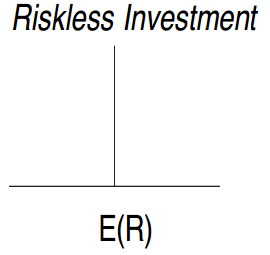
The financial industry is rather torn about how to handle the criticisms of risk. Risk is far too important to their industry for them to accept changes that significantly lower risks. Let’s give a brief illustration of what risk means to finance. Before the United States’ credit rating was downgraded to AA+, U.S. Treasury bonds in a one year period were practically a risk-free investment: there should be no difference between your expected return and actual return. That looks like this:

risk free


Where is the variance curve? There is none: the actual results will always line up with expected results. Now let’s look at hedge funds, as conveniently set next to the more secure mutual funds:


YTD HF performance_1


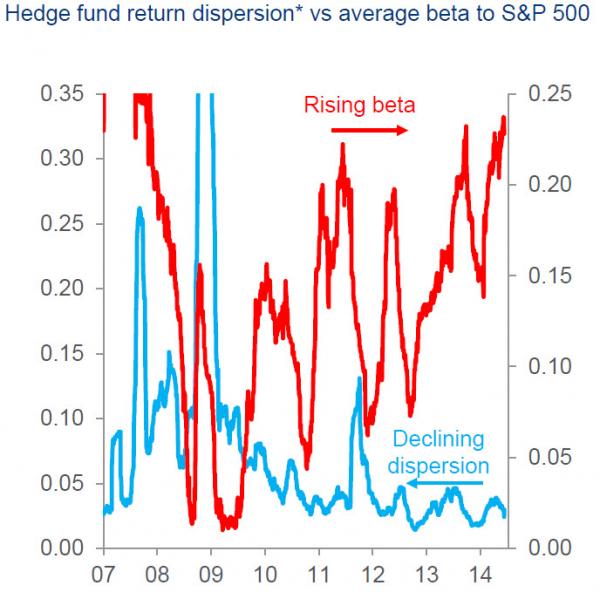
And the risk of hedge funds, despite providing unconscionable high returns during the housing bubble and the recession, has steadily been increasing.


20140621_ABC2_0


And since banks started making these sorts of investments post-Glass-Steagall, their standard deviations have on average increased. A simple, non-causal relation I’m sure.

And that is precisely what is criticized in “Reconsidering…”: “a correlation between the proprietary trading activity and the losses certainly existed, but not a significant causal relationship” (34 No. 6 Banking & Fin. Services Pol’y Rep. 1, 3). Madison et al. instead say that the problem is in “supersenior” collaterized debt obligations (CLO’s). Blaming CLO’s is convenient for industry shills: “supersenior” CLO’s are not stratified into risk tranches, under the mistaken belief that properly construct CLO’s could not completely default. The problem with that belief: (1) quite a few CLO’s were not properly constructed (2) there was risk, and the banks hid it in undercapitalized bond insurers. In both these instances, you have causes of the collapse that are easy to atomize into the fraud or mistakes of a few “bad apples.” So if CLO’s are the main problem, what is Madison et al.’s solution? Capital requirements. In 2004, the S.E.C. allowed the largest broker-dealers to apply for exemptions. Because that exemption is still in place, it gives the more conservative critics of the recession a solid campaign target to obfuscate their agenda to chip away at Dodd-Frank piece by piece. The Financial Crisis Inquiry Commission Report (FCIC) does talk about how thin capital was an important factor:

In the years leading up to the crisis, too many financial institutions, as well as too many households, borrowed to the hilt, leaving them vulnerable to financial distress or ruin if the value of their investments declined even modestly. For example, as of 2007, the five major investment banks—Bear Stearns, Goldman Sachs, Lehman Brothers, Merrill Lynch, and Morgan Stanley—were operating with extraordinarily thin capital.FCIC Report pg. xix

But here are the problems: first, the bad apple theory finds no correlation between the indisputable direct actors of the crisis and actors subverting capital requirements through the 2004 exemptions. Not only was Bear Stearns, public “bad apple” enemy number one, within the current capital requirements, they also happened to be within the pre-2004 capital requirements as well. It turns out that leverage held by the investment banks was not the fault of the 2004 exemptions at all:

Leverage at the investment banks increased from 2004 to 2007, growth that some critics have blamed on the SEC’s change in the net capital rules…In fact, leverage had been higher at the five investment banks in the late 1990s, then dropped before increasing over the life of the CSE program—a history that suggests that the program was not solely responsible for the changes. –FCIC Report pg. 153-154

The FCIC Report is being generous in saying “not solely responsible.” The capital requirement exemptions were not in anyway a major factor in the recession. They are merely a convenient scapegoat for the ill-informed and the zealots of free-market ideology. Such scapegoating is possible when the inability to see the forest from the trees pervades U.S. understanding of economics, or rather the inability to see the inherent contradictions of capital from the specific manifestations of it in various financial factors and instruments. As David Harvey points out, these contradictions are never actually solved, but rather moved around. His focus, as a geographer, is how this is done geographically, noting the examples of the U.S. to Brazil and the West to Greece. But geography is only one facet of place – financial investments, I would argue, are another. And this is the fundamental nature of capital; Karl Marx in Grundrisse states that-

…[capital] already appears as a moment of production itself. Hence, just as capital has the tendency on one side to create ever more surplus labour, so it has the complementary tendency to create more points of exchange…The tendency to create the world market is directly given in the concept of capital itself. Every limit appears as a barrier to be overcome. –Grundrisse pg. 334

And as finance experiences growth, it creates more points of exchange, which means more trades, in shorter time, with far more risk. Thus, the futility in “solving” the problems which caused the recession by imposing a single regulation that merely attempts to limit, not even growth itself, but the speed of growth. Madison et al.’s claim that short-term exchanges are not at issue is farcical. Bear Stearns demonstrates, about as clearly as one can get, that the singular function of lax capital requirements is not needed to engage in risky growth and, as Marx states in Grundrisse, such haphazard search for more points of exchange is intrinsic to capital itself.

But the Volcker Rule is hardly exempt from this criticism either, though built on slightly stronger foundation. As a Marxist myself I do not believe that there could ever be a set of regulations capable of preventing the uncontrollable swarming of capital. But while “every limit appears as a barrier to be overcome,” some barriers are far easier to overcome than others. The Volcker Rule certainly sets stronger, though not impermeable, limits to the reproduction of the conditions that created the recession than any single capital requirement ever could.

An apt analogy would be three “average people” in a race against one another. One runner is given a track that is simply a one mile line, and not given any restrictions. The second runner is given an identical track, but told “You can only run at 7 mph at any given time. But we will only check your speed once in the race, and will give you 30 seconds to slow down if you’re over the limit.” The last runner is given a labyrinth where the correct path is one-mile long, but allowed to run as quickly as they want. The first runner and second runner will likely have identical times: the average one mile time of a person is 8:18, or about 7.22 mph. That additional 0.22 mph could easily be made up while the referees are not watching. The last runner will likely have the worst time. Unlike the second runner, the last runner has actual limitations to how they can run.

But the Volcker Rule itself contains a number of loopholes, most notably the convoluted (d)(1)(G) exception to certain activities around hedge funds and private equities or the provisions governing activities outside the United States in (d)(1)(H) and (d)(1)(I). The confidence of the banks themselves in the face of the impending implementation of restrictions this coming summer may indicate that they have found, or expect to find, a means of subverting the Volcker Rule. Regardless, the specific naming of proprietary trading, private equity, and hedge funds allows future financial instruments that can be defined outside of these while serving similar functions to be engaged with by banking entities. In other words, the Volcker Rule may not be a labyrinth as much as a fork, one path with a dead end and the other leading to the finish line. How effective it will be is far too dependent on a large number of circumstances for Leftists to be comfortable with it even in the short term, and that is not even counting the 13 proposed pieces of proposed legislation (a political analysis of their viability would take far too long to go into here, but worth noting nonetheless).

Another piece of proposed legislation could alter the Volcker Rule if enacted, and that’s Elizabeth Warren and John McCain’s 21st Century Glass-Steagall Act. While hardly the means of putting an end to any triggering of mass dispossession by recession, the strict separation of banking activities significantly reduces the effect of risky financial actors on commercial banks, as well as ending poor assessments of risk that give undue power to diversification of investments regardless of the kind of investment. Further, for those of us interested in pushing for worker cooperative banking, nationalized banking, public banking, etc., a Glass-Steagall reinstatement would decrease the short-term competitive edge commercial banks have by investments too risky for small, community or municipal public banks to take on. While it only has six co-sponsors and the bill’s prospects are rather grim, the idea has enough popularity to stay in the media, albeit with a far less Leftist lens than I give it.

But we can all act on this issue immediately in two simple ways. The first is to refuse the resignation to commercial banks being above the law and regulation. To refute the rewriting of history to claim that the recession was not caused by a lack of regulation. To state plainly that the banks got bailed out and we got sold out, and that we cannot accept that as business as usual. And the second is to divest. Divest from predatory financial institutions. Divest from the big commercial banks that have profited from investing in those institutions. Stop making investments with the sole goal of profit, and start taking conscious measures to avoid the schemes that hurt people of color, women, and the working class. To do so completely is impossible: there is no ethical consumerism when capital only exists from the surplus value extracted from labor. But to change that larger problem requires rebuilding society in a way that will be made far more difficult if our communities are torn apart by increasingly brief gaps between recessions.

Read Part 2 on Orderly Liquidation Authority here.

Support my work through a $1 or $5 donation!

The End of Dodd-Frank

6281762077_bc5ab9a1d5_zMost Leftist groups face a fairly unwieldy task of challenging a whole range of complicated issues with far less funding and time than their conservative counterparts. That is compounded by an overall focus on trying to prevent individual people from suffering which, while a noble endeavor, does not change the conditions that created that suffering.

So I want to start producing more technical legal but no less radical analysis, especially for the purposes of crafting both policy for the near future and setting our sights on some more distant visions of a socialist world. These are obviously the conjectures of a 1L student with a rather transparent agenda, so take that for what it is worth: if anything, this exercise is more to build up my own experience. I welcome any criticisms that readers may have.

I have three series planned so far, on issues with a rather abysmal lack of Leftist insight, at least in the legal realm. The latter two, because I do have many colleagues in friends in the respective field, will be released much later, and those will be on Prison Abolition and Constitutional Crisis. The first, which I will start immediately, is on the Dodd-Frank Act. With a Republican-controlled Congress enacting revisions to the financial regulations, revisions crafted by the lawyers of the banking and finance groups, it seems like a timely subject in need of an injection of truth. Because these lawyers are attempting to rewrite history, somehow re-constructing the recession as the fault of regulation and restriction. Here is what I am planning to cover:

Part 1 – Thus Spoke Volcker: The Volcker Rule, U.S.C. 1851, is essentially the consolation prize for advocates who failed to reinstate the Glass-Steagall Act. It prohibits banking entities from (1) engaging in proprietary trading and (2) having any pecuniary interest in a hedge fund or a private equity fund. The challenges to it are eloquently summed up in Madison, Cohen, and Shirley’s “Reconsidering Three Dodd-Frank Initiatives”: Risk, Liquidity, Complexity, and Competition. I’m going to pick apart how circular the logic of these challenges are, how their claims of wanting to reduce risk ring hollow, and how segregation between the banking industry and such risky financial institutions and instruments is crucial to preventing a virtual replication of the recent recession in a matter of a few years. In fact, that will happen because the Volcker Rule just is not the Glass-Steagall Act. With the recent repudiations of some of the very people who formerly championed the end of the act, the time for its reinstatement could be at hand.

Part 2 – But Who Will Save OLA?: The Orderly Liquid Authority was put in place to allow the government to intervene in financial corporations where normal bankruptcy is not possible. The collapse of Lehman Brothers was, in large part, unstoppable due to the inability of such intervention. The OLA is being challenged on a number of constitutional grounds, namely the First Amendment, the Due Process Clause, and the Takings Clause. I will refute that the OLA is unconstitutional, and further assert that its authority should be extended beyond the current scope of agencies. While it would be delusional to think that such Keynesian measures will stop another crisis of capital from ever occurring, the regulations need to be extended to at least temporarily prevent any further dispossession of wealth from the working class, and especially the Black working class, communities.

Part 3 – The Chilling Effect of Capitalism on Stability in the Congo: Here I will talk about a portion of the Dodd-Frank Act which have been chipped away by stare decisis. The constitutional arguments largely lean on the recent move to extend First Amendment protections to corporations. This trend is dangerous, and may require legislative intervention to really prevent. That is unlikely to happen with the current composition of Congress, so I will explore alternatives to the arguments the S.E.C. and others have failed with.

Part 4 – Financing a Democratic Future: Why should a socialist care about regulating an industry which they find to be inherently oppressive? Here I will explore the pros and cons of fighting for reforms, raising consciousness among the working class about how capital functions, and what role the legal profession can play in pushing for public ownership of the banks and other means of financing cooperatively owned businesses.

Client-Centered Lawyering: Critiques and Alternatives

While the divisions in the Left are abundantly clear when broken down into the various factions and ideologies, in my admittedly anecdotal experience there is considerably less friction when individuals are grouped under an identity umbrella, whether that be broad (queer) or narrow (hard femme MAAB people), experience-based (sexual violence survivors) or career-based (therapists). And that has been my experience both in the legal profession and the broader movements around them. In the prison reform/abolition movement, you have respectable legal organizations like the ACLU working with the most stringent of anarchists and no one bats an eye, though maybe snide comments are said under breaths and passive aggressive tweets are made.

Perhaps it is this cohesion that explains the progressive legal community’s affection for the term “client-centered lawyering.” Client-centered lawyering is exactly as it sounds: a mode of practicing the legal profession where the client’s autonomy is at the forefront. To a certain degree, adherence to a client’s will is not just a matter of politics: it is required by the law. But in public interest law, especially service provision for the so-called indigent clients, this requirement takes on a new life. The lawyer, through their relative privilege and power, becomes a vehicle and megaphone for the client to be able to participate in legal processes without a complete disadvantage. A noble self-sacrifice of the lawyer’s own rationale. Of course a lawyer is generally expected to advise clients when they believe a client’s decision is unwise, but at the end of the day the client is the driver and the lawyer has little choice but to go where they are led.

With all due respect to the many admirable people who advocate the client-centered model, I believe that model is inherently neoliberal in its scope. After all, the rulers of the United States love nothing more than to atomize people into individuals rather than communities: it is easier for them to fight a working class person with a lawyer than a thousand working class people, especially if that lawyer has another 30 clients on retainer. The term “client” itself prescribes a role: the person to be fought for rather than the person who fights, the person who needs services rather than the person who needs solidarity. As someone who was in the nonprofit industry, I saw firsthand how quick even the more Leftist workers were to classify people as one or the other. After all, it is required for all the inane metrics by which the success of a nonprofit is haphazardly measured. And while client-centered lawyering is certainly a better alternative to the careerism that permeates the private sector of the legal profession, it is one that fails to challenge in anyway the predominant mode of relation. It obfuscates that even for the indigent client, the relationship is not one of solidarity but one of economics, and to make matters worse often with the purse strings not in the hands of the community but rather a few wealthy donors or foundations. Perhaps Soros-centered lawyering would be a more apt term if I want to be rather sharp about it.

But I do also want to get to what I see as an alternative. The libertarian-tainted Left posits that community and individuality can be reconciled, and I would attribute that delusion to many of the problems we have, especially in the legal realm. After all, while the economic bottom rung of the LGBTQI community has been left to starve, the individual right to marriage equality was won in Obergefell precisely by the idea that concepts as ideologically distinct as Due Process and Equal Protection are in constitutional wedlock. While the financial state of the Black community has been so resolutely obliterated by the recent recession and failed to make a productive recovery, we are told from Ben Carson to Beyonce that progress is being made due to the individual success of a Black elite.

We have to get creative. Class actions could very well go extinct by the recent death blows dealt by the Federal Arbitration Act et al. Movement lawyering, while certainly needed, is in large part stretching the resources and time of most of its participants since it is nearly always voluntary and unpaid. But we can do something right now, and that’s to make a material commitment to stop the prioritization of service provision, what can become a hopeless race within a system where it is literally impossible for us to win. We need to stop justifying atrocious labor practices that too much of the “public interest” world is willing to engage in. We need to bring democracy to the field, to create alternatives to institutions like ALEC or even the American Law Institute. One friend of mine told me that something like the Trans Pacific Partnership is too big-politics for people like us. That’s so utterly foolish. All that is required is a change in direction, and a refusal to give in to the dominant paradigm. It is risky. But more importantly it is radical, and asserting a radical belief in humanity, not just in a person but in humanity, is the first step to create a lawyering practice that works with the underclass of the world.

Support my work through a $1 or $5 donation!

Why Is Arkham So Full?: The Truth About Insanity Defense in Criminal Law

I’ve been watching a show called Gotham recently. I’m a comic book nerd, like seeing strong women of color characters, and have a soft spot for any Law & Order type shows. One thing that makes the show quite unbearable at times is their portrayal of mental illness. They trick you by having protagonist Jim Gordon question the mass incarceration of the mentally ill at Arkham, but once he’s there as a security guard he’s more than happy to demean and manipulate the mentally ill as much as all the other neuro-normative, as in those without mental illnesses, characters. The mentally ill people incarcerated there are a collection of stereotypes, from the manchild to the flamboyant gay man. And of course one strange thing about the show, and about the Batman universe in general, is just how full Arkham is. Arkham pretty much has served as the de facto prison for most of Batman’s villains, even for those are supposedly “sane” like the Penguin or Black Mask.

In the real world, insanity defense are fairly rare, as demonstrated by the high rate of mentally ill persons in US prisons. Only 1 in 100 defendants even raise an insanity defense and the chance of the defense being successful is less than one percent. The misconception that it is more prominent stems from both the general fear and stigma around mentally ill people and the use of insanity defenses in highly publicized serial killer cases like Jeffrey Dahmer (thinking I might do a whole post about serial killers at some point if there’s any interest). Of course the state, and the capitalists it represents, have a very vested interest in incarcerating people with mental illness rather than having them treated at an in-patient facility (though in-patient facilities have their own problems, often associated with a general lack of funding by the state and a focus on diagnostic treatment rather than working with patients cooperatively). People with mental illnesses range from being disruptive to completely incompatible with a capitalist economy. 80% of mentally ill people are unemployed. The alienation and need for sublimination with in a capitalist economy is something that many of the mentally ill people simply cannot do or tolerate. But unlike their neuro-normative fellows, they are poor candidates to make up what Engels refers to as “an unemployed reserve army of workers.” Most of this “reserve army” is sustained by what Engels refers to as huckstering but what we now call hustling. Such hustling, whether in drug, piracy, or sex work, is incredibly mentally strenuous work. Which is not to say that mentally ill people do not engage in such work, but rather that it is not nearly as feasible for them to sustain themselves on it, and as Engels wrote, it reduces their options to begging.

Getting back to the insanity defense. Fun fact: most insanity defenses (decided by the states and one federal form) are based on a test from the 1500’s called the M’Naghten Test. This test is pretty simple: did the offender, with a defect of reason or disease of the mind, understand the difference between right and wrong? It would be laughable if it weren’t so blithely out of touch with both modern science and organizing done by mentally ill people for their rights. But wait, it gets much worse. Because this test could have gone the way of other 16th century institutions like serfdom.

The Chief Justice of the Supreme Court of New Hampshire, Charles Cogswell Doe, had a problem. Defendant was being charged with murder in the commission of a robbery (note that this was before felony murder rules had been established in many places like NH). Defendant had what at the time was called dipsomania, what we would now call alcoholism. The judge established a new test: that insanity defenses could be applied in cases where the crime was a product of mental defect or disease. Whether or not that was the case would be left up to the jury in their role as the triers of fact. Despite the problematic language, this was a huge step forward from the ludicrously high standard of the M’Naghten Test. And it was in 1870. It is generally referred to as the Durham/Product Test.

Having an insanity defense that could actually work was troublesome to capitalist lawmakers for another reason than the desire of warehousing an untenable population of unemployment. Guilt is a crucial aspect of the criminal legal system. Insanity defenses are “excuse defenses,” defenses that find a person normally guilty of the crime not guilty. Their existence has a basis in the representation-reinforcement school of thought: if you do not excuse certain defendants who are extremely sympathetic to the working class, it could both cause dissent to the government and reveal that the purpose of the criminal law is not as moral or socially responsible as it purports. Writes Evgeny Pashukanis:
Guilt… is the basis for the gradation of punishment – a new, if you wish, ideal or psychological element, which is combined with the material element (the injury) and the objective element (the act) – in order to provide a joint basis for determining the ratio of punishment…bourgeois jurisprudence ensures that the transaction with the criminal is in accordance with all rules of the art, i.e. that each may be convinced, and may verify that the payment is justly set (public judicial proceedings), that the criminal may bargain freely (adversary process), and that in so doing he may use the services of an experienced judicial expert (admission of the defence) etc. Briefly, the state conducts its relationship to the criminal within the framework of a bona fide commercial transaction in which there are, ostensibly, guarantees of criminal procedure.

So critiques were put forth against the Durham/Product Test that it puts too much emphasis on mental health experts. We have in this critique an interesting contradiction: on the one hand, it is legitimate to wish to avoid too much emphasis on the ambiguity that is witness experts (a topic for a later date I’m sure), but on the other hand, who else has the credentials to inform a juror’s choice on an issue explicitly about mental illness? With the publishing of the Model Penal Code in 1962, the American Law Institute sought to reinforce the certainty necessary for capitalist law, and insanity defenses were no exception. Model Penal Code section 4.01(1) adopts a version of the Irresistible Impulse test: that the defendant lacks substantial capacity to know criminality or conform their conduct to requirements of the law. Other criminal codes go further, such as the New York Penal Law which essentially revives the M’Naghten Test.

An actionable insanity defense that is not fatal in fact could be a means of questioning the purported morality and purpose of the criminal law. Remember that not all defenses are created by statute: the use of the “battered woman syndrome” defense, which faced major opposition when first used by defense lawyers who had gone outside of the defenses outlined by statute, is now practiced across the country. Similarly we need new defenses for people with mental illnesses that are not restricted by the prejudiced and exploitative definitions of capitalist law.

Support my work through a $1 or $5 donation!

No Consideration For The Alienated Worker

State Archives of Florida, Florida Memory. Working in the refining industry in the early 20th century was incredibly dangerous for the low-wage workers, whose labor built wealth that is still held today by the great-grandchildren of the capitalists of that time.

I know I have already touched on this with both the law and with contracts in particular, but invariably there is the temptation to dismiss the system wholesale as a completely disingenuous legal fiction only meant to give the veneer of legitimacy to the undemocratic operations of the capitalists. And I do not deny that the system has no democratic or empirical legitimacy. But it is important to understand how the system works nonetheless, because capitalists have constructed them meticulously to serve the different functions of dispossession and exploitation needed to create wealth and sustain the system itself. Thus we can construct a number of useful correlations between legal mechanisms and economic or political concepts in order to chip away at the system until there is sufficient consciousness to do away with it entirely.

Aside from the bourgeoisie academic Marxists who have the problematic “noble-savage” notion of the working class, most of the Left recognizes an overwhelming need for raising consciousness among the working class. Consciousness is in a dialectical relationship with alienation, and there are four kinds of alienation in Marxism:

  1. Alienation of the worker from the products of their labor
  2. Alienation of the worker from the production of their labor
  3. Alienation of the worker from the self as a producer
  4. Alienation of the worker from other workers

Consequentially, the Left has designed a number of means to counter each of these alienations, both broadly and specifically. Here a few illustrative examples.

  1. To counter alienation from the products of their labor, the adoption of profit-sharing.
  2. To counter alienation from the production of their labor, the use of collective bargaining.
  3. To counter alienation from the self as a producer, the creation of cooperatives.
  4. To counter alienation from other workers, organizing in unions.

And in turn, capitalists and their state retaliate against this resistance with:

  1. Outsourcing.
  2. Company-controlled contracts.
  3. Price undercutting
  4. Right to work laws

In my contracts class, we read a case called Plowman v. Indian Refining Company (20 F. Supp. 1 (E.D. Ill. 1937)) that relates to each of these four types of alienation, but for the sake of brevity I am going to focus on the use of “consideration” requirements to determine the enforceability of contracts, and how it was used in this case to alienate workers from the products of their labor and from themselves as producers.

Plowman is a great example of a case where the judge made his ruling not simply to resolve the legal issue but to formulate policy not even needed to resolve the issue at hand. Because in the legalistic sense, the workers did not have a bit of a case. Their administrators (the court’s ruling occurred after many of the workers had died) sought to collect money promised to them, claiming that the company had guaranteed it for life and that they had terminated the arrangement less than a year later. At evidence was a letter which read:

…Effective August 1, 1930, you will be carried on our payroll at a rate of $_______ per month. You will be relieved of all duties except that of reporting to Mr. T.E. Sullivan at the main office for the purpose of picking up your semi-monthly checks. Your group insurance will be maintained on the same basis as at present, unless you desire to have it cancelled.

[Signature of the vice-president]

There are two reasons why this letter is not enforceable that have nothing to do with consideration. The first is the lack of essential terms and the ambiguity created therein. Specifically, there is nothing in the letter to demonstrate that the offer was for payments until the end of the workers’ lives. Therefore, it fails at being an offer to enter into a legally binding contract, and is merely a notice of what the company plans to do.

The second is that the vice-president was not authorized to make this agreement. The laws around civil liability of corporations for their employees’ actions is a labyrinth of obfuscation to protect corporate actions. It is the power of agents to bind their principals, and the vagueness of its terms (i.e. agent’s actual authority is to perform “acts necessary or incidental to achieving the principal’s objectives”. Restatement (Third) of Agency § 2.02(1).) gives corporations considerable leeway.

In other words, the agreement was not binding. However, the judge created a hypothetical where both of these issues were not present so that he could address consideration. I have found few terms in contracts that more profoundly reifies social relations into commodity relations. It is a cruel irony that the term is called “consideration,” as it serves as crucial foundation for the purging of social considerations in a capitalist society.

More far-reaching than currency and a step-child of debt even more sadistic than its parent, consideration is the notion that contracts require a thing of value to be exchanged for a performance of promise. Particularly, the law wants consideration to be the inducement of benefit by detriment or detriment by benefit, the so-called bargain theory of consideration. Increasingly moving away from even feigning an interest in “fairness,” the courts do not police equivalency of this exchange, and the presence of value in either benefit or detriment is measured solely in exchange value. Consideration fills the “social welfare”-shaped hole in capitalism’s social organization. While its fellows “offer” and “acceptance” are, to a certain degree, a part of democratic organization, consideration is wholly a legal fiction of the capitalist world. What György Lukács wrote on reification demonstrates just how powerful the concept of consideration is:

Its basis is that a relation between people takes on the character of a thing and thus acquires a ‘phantom objectivity’, an autonomy that seems so strictly rational and all-embracing as to conceal every trace of its fundamental nature: the relation between people…The modern capitalist concern is based inwardly above all on calculation-Lukács “Reification and the Consciousness of the Proletariat”

Lukács goes on to write that this system renders judges into statute-dispensing machines for the capitalists. Pardoning his ignorance on the specifics, it is very much true that consideration allows judges deciding cases to weigh exchange value over social value in nearly every instance.

Plowman presents a rather blatant example of this since the plaintiffs had the audacity state that there was “moral consideration” even if there was no consideration through exchange value. “However strongly a man may be bound in conscience to fulfill his engagements,” writes Judge Lindley, “the law does not recognize their sanctity or supply any means to compel their performance.” Judge Lindley then goes on to emphasize that he of course values that old workers are provided for, and extols the virtues of the old poorhouse system. Rather, the court requiring a company to do so would be overreaching its power, a power that should be left up to the legislature. What was this moral consideration? Mostly it was the past work of the workers. And what better way to alienate workers from the products of their labor and from themselves as producers than to legally declaring that their past work (the infrastructure they built, the new workers they trained, and simply the labor by which they produced value) has no value in consideration.

As Friedrich Engels wrote in The Principles of Communism:

Labor is a commodity, like any other, and its price is therefore determined by exactly the same laws that apply to other commodities. In a regime of big industry or of free competition – as we shall see, the two come to the same thing – the price of a commodity is, on the average, always equal to its cost of production. Hence, the price of labor is also equal to the cost of production of labor. But, the costs of production of labor consist of precisely the quantity of means of subsistence necessary to enable the worker to continue working, and to prevent the working class from dying out. The worker will therefore get no more for his labor than is necessary for this purpose; the price of labor, or the wage, will, in other words, be the lowest, the minimum, required for the maintenance of life.

There is no consideration, by the capitalist or humane definition, for the alienated worker. And their denial of social welfare is heralded by the paradoxical waxing-poetic of how our society values its workers.

Support my work through a $1 or $5 donation!

Atomizing Black Students

Few things pique the fury of the right wing quite like affirmative action. While affirmative action refers to a broad political range of actions taken to empower or uplift the disenfranchised, conservatives and even many liberals see affirmative action as one thing: cheating. That people of color who benefit from affirmative action are not working as hard, not achieving as much, and still asking for all the “rewards” of a college education or secure living wage job. This social narrative of cheating is as old as the Protestant work ethic, but in a world where media access has made us increasingly more empathetic to each others struggles, the capitalists are rightly concerned that we are gradually becoming more non-receptive to these arguments. Some capitalists are going with the flow, embracing diversity as just a new commodity to be owned by the bourgeoisie to exploit the working class. Other capitalists are worried about even conceding this ground, that it would create conditions of “racial balancing” (reparations, returning land to communities, etc.) that could seriously disrupt the social hierarchies that have helped sustain capitalism for the past 500 years. Outside of the tech industry and the nonprofit industry, this line in the sand attitude is the one held by most capitalists. While groups like McDonald’s and Victoria’s Secret will have anti-discrimination policies, these are meant to govern the relations between the lowest workers and their immediate management. In Fisher v. University of Texas (2013), there were many amicus briefs from major corporations filed in support of affirmative action.

However, these briefs can fairly be seen in totality as a PR move rather than a political move. Because groups that these corporations and their executives fund also filed amicus briefs, but in support of the petitioner. The CATO Institute, the Center for Individual Rights, the American Civil Rights Union, Judicial Watch Inc., Center for Constitutional Jurisprudence, and most of the judges on the majority opinion receive donations and funding from major corporations like Coors-Miller, the Koch Brothers, Walmart, Amway, BNY Mellon, Olin Corporation, and the Alleghany Corporation. Most of these corporations are international conglomerates that have controlling stakes in the majority of businesses in the United States, particularly through financing. William C. Richardson is a great example of this: in 2007, he was on the board of both Kellogg (filing for affirmative action) and BNY Mellon (filing against affirmative action through their various think tanks). It is also no coincidence that Richardson is now part of the Exelon Committee on Corporate Governance and CEO Emeritus of the W.K. Kellogg Foundation. This duality is necessary to maintain the illusion that the corporations which directly sell to individual consumers are on our side and care about the things that we care about. If it was clear that all the corporations were against working people, especially working people of color, it would necessarily create consciousness beyond the alienation that is experienced in the society of the corporate spectacle. This atomizing of individuals is the main purpose of constricting and preventing affirmative action.

Sandra Day O’Connor, as much as I wish it were not so, is one of the most important judges in the history of the United States. Particularly she was successful in laying the framework for a neoliberal border for affirmative action to not go beyond in Grutter v. Bollinger and Gratz v. Bollinger. Basically, the standard was placed on a scale of “racial quotas/balancing” to “holistic, individual diversity evaluation with a good faith effort to pursue race-neutral means.” This holistic standard has not satisfied either side: as represented by Justice Ginsburg, it is seen as unnecessary “subterfuge” that bounces around the issue of affirmative action, and as represented by Justice Thomas, it is seen as a standard that perpetuates racial classifications. These sides were pitted against one another in Fisher I, but the Court failed to deliver a strong opinion overruling Grutter or Gratz. Instead, Kennedy attempted to gut Grutter by saying that the “good faith consideration of race-neutral alternatives” had to be a “good faith demonstration of race-neutral alternatives” to a court. As such the case was remanded back to the Texas court. But what happened next was very surprising: the Texas court doubled-down, stating that because race was so entangled in a holistic review of diversity that it would create more of a racial classification to try to eliminate race from the admissions method.

The CATO Institute perhaps phrased the conservative view best in an amicus brief to the Court for the upcoming Fisher II case when they said that holistic review was “opaque” and as such could hide “racial balancing.” Here I believe the CATO Institute is being more intellectually astute, albeit with astounding amorality, about the issue than many of their liberal counterparts. They have recognized that Sandra Day O’Connor’s attempt to make holistic review into a tool that atomizes people failed, that the social understanding of race is such that any classification of race opens a window to the ability to recognize people not as individual failures but rather as people who as a community have been exploited and oppressed. To give it a Trotskyist spin, CATO recognizes that affirmative action could be used as a transitional program to raise consciousness among people of color. That what is blamed on “individual failings” is more accurately tied to legacies of history and the material oppression carried out by corporations and the state. From Columbus Day to Abraham Lincoln being portrayed as against racism, the capitalists try their best to create hegemonic narratives that deny any history that could provide an explanation for the poverty and violence of communities of color outside individual “laziness”, “savagery”, etc. Affirmative action’s danger to the ruling class has never been that it would allow the lazy to get rich or even, as Clarence Thomas would say, that it will make people have negative perceptions of people of color. Rather, the danger is that it would awaken people to the possibility that they deserve not only the facade of “equality of opportunity,” but reparations for the 500 years of colonialism and white supremacy waged against their communities.

Yikes! Reparations are a quick way to summon the ire of even the more liberal capitalists. And the liberals who support affirmative action will do everything in their power to avoid it. They will claim that their support for affirmative action derives from “diversity” being a compelling governmental interest, particularly for its ability to “break down stereotypes” and thus allow “all students to explore, develop, and express their individuality” (from the NAACP’s amicus brief in Fisher). Joshua Civin, counsel to the director of litigation at the NAACP Legal Defense Fund, Inc., wrote the following in an op-ed for The American Constitution Society:

An admissions system that relies exclusively on class rank may overlook students who take intellectual risks by enrolling in demanding classes outside their comfort zone.  Or prodigies who focus all their energy on a subject in which they excel.  Or late bloomers like Albert Einstein.

In an op-ed about use of racial classifications in university admissions, Civin does not cite any of the reasons why racism specifically could impact students. Instead, he cites race-neutral, capitalist-appealing  traits like taking risks, being a prodigy, and commodifying their talents. And wouldn’t an example of a scientist who could not start work as early as their white counterparts because of economic and social constraints be more appropriate, like Roger Arliner Young? As Ta-Nehisi Coates wrote in his essay “The Case for Reparations”:

This confusion about affirmative action’s aims, along with our inability to face up to the particular history of white-imposed black disadvantage, dates back to the policy’s origins…America was built on the preferential treatment of white people—395 years of it. Vaguely endorsing a cuddly, feel-good diversity does very little to redress this.

There will be no happy ending to this story through any definition of affirmative action established by the Supreme Court. Whatever hopes there were to use affirmative action as a tool to build consciousness were squashed when the CATO Institute and their associates realized how dangerous even an atomized version of affirmative action could be. But there is hope. You cannot atomize reparations. You can not say that reparations need to be handed out as part of individualized holistic assessments of welfare benefits. And most importantly, there is no race-neutral gloss of why we should support reparations. There are plenty of questions to be answered: how would reparations intersect with transferring ownership of the land and property to communities? How would reparations work on an international scale? But the simple assertion of supporting reparations already takes us far past the pathetic standards held in Grutter and Fisher. Who knows where they could take us.

Struggles for reparations have already seen some unprecedented victories in the past few years. Here are just a few:

Survivors of Chicago Police Torture

The people of Jamaica

The people of Haiti

Farmer-Paellmann v. Brown & Williamson

Support my work through a $1 or $5 donation!