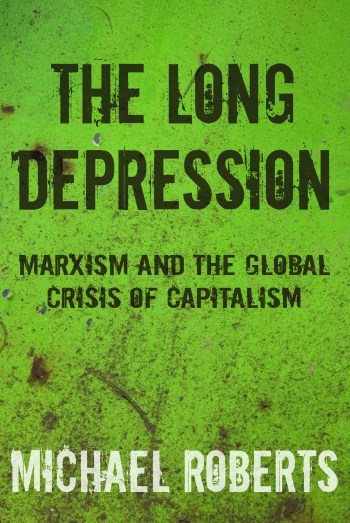
 Last night I finished Michael Roberts’s new book The Long Depression, an epic defense of Marx’s law of political economy that the tendency of the average rate of profit of capital was to fall and an argument that the world is in a long depression, the third economic depression since the rise of capitalism. Readers may recognize the author as I have often cited to the prolific work he has done on his blog, as well as recommending him to all of those who want a solidly Marxist perspective on economics. The book provides an exhaustive computation of the effect of Marx’s law, as well as refutations of a number of alternative explanations (Keynesian, neoclassical, Austrian school, monetarist, Ricardian, etc.) for the economic history of the world from 1873 until the present day. It is a fantastic book not only for Marxists eager to learn more about economics but for Marxists to share with STEM-oriented friends who are more receptive to Roberts’s quantitative focus than to the more sociological arguments for Marxism.
I knew I had to write something promoting this book but I’m at best an amateur economist, so my judgment of Roberts’s argument is not particularly useful. However, I can highlight the arguments of the book by putting forth my own supplement on how the U.S. law correlates to the economic phenomenons that Roberts describes. As the proposal to reinstate the Glass-Steagall Act emerges from the shadows it has lingered in for over a decade, it is crucial to understand how a capitalist economy works and what effect the laws have on them.
 Habeas Quaestus